
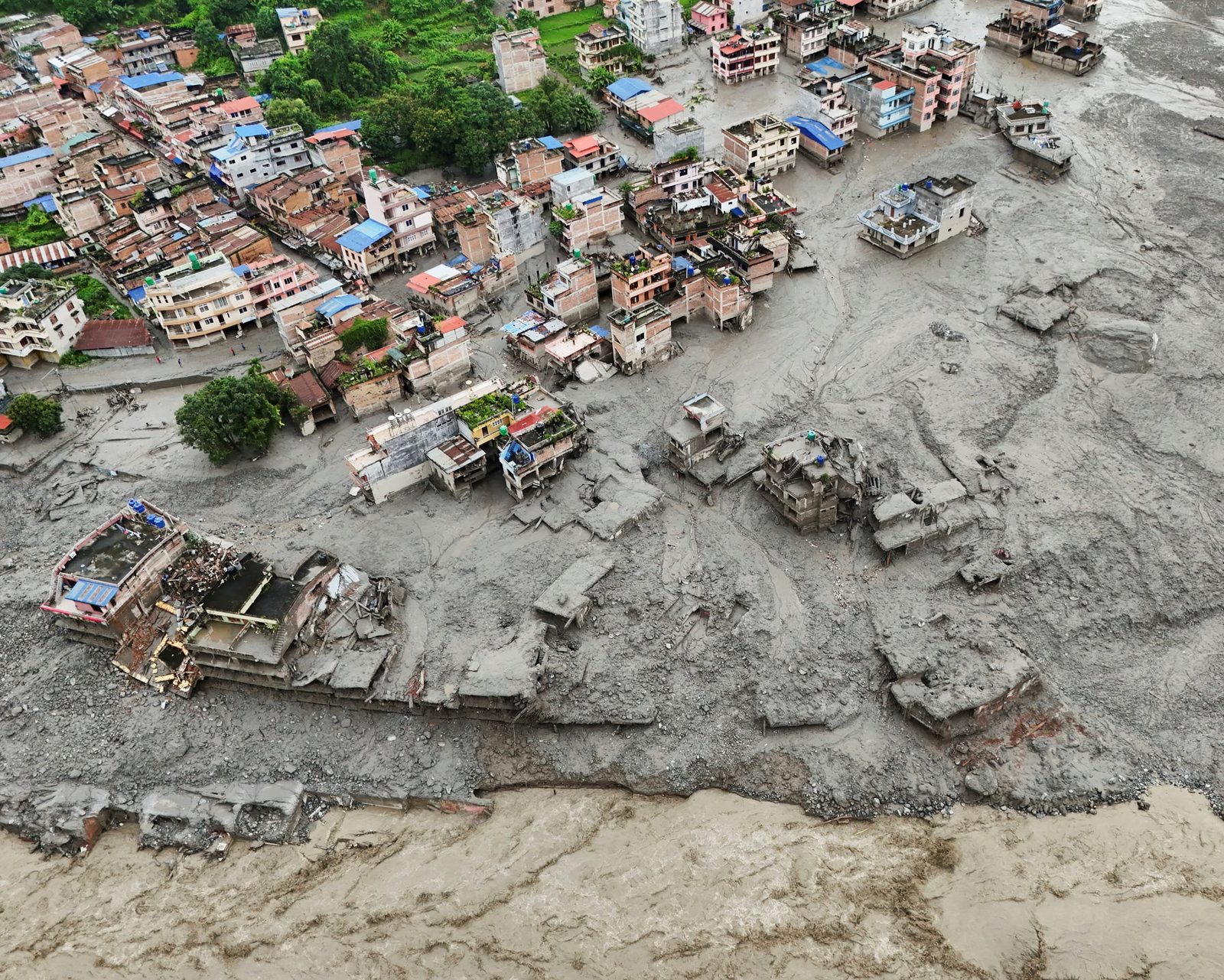
(Photo: Navesh Chitrakar/Reuters)
Warta Kema – On August (26/9), the Nepal-Tibet border was struck by a flash flood that affected 65,000 people. Now, more than two weeks have passed since the incident. Homes are destroyed, thousands of people remain missing, and the death toll continues to increase. What triggered this disaster was not immediately clear, but findings show that climate change may play a part in this cause. The cruel irony? Nepal, which only contributed 0.1 percent in greenhouse gas (GHG) emissions, paid the ultimate price.
The Trigger High in The Himalayas
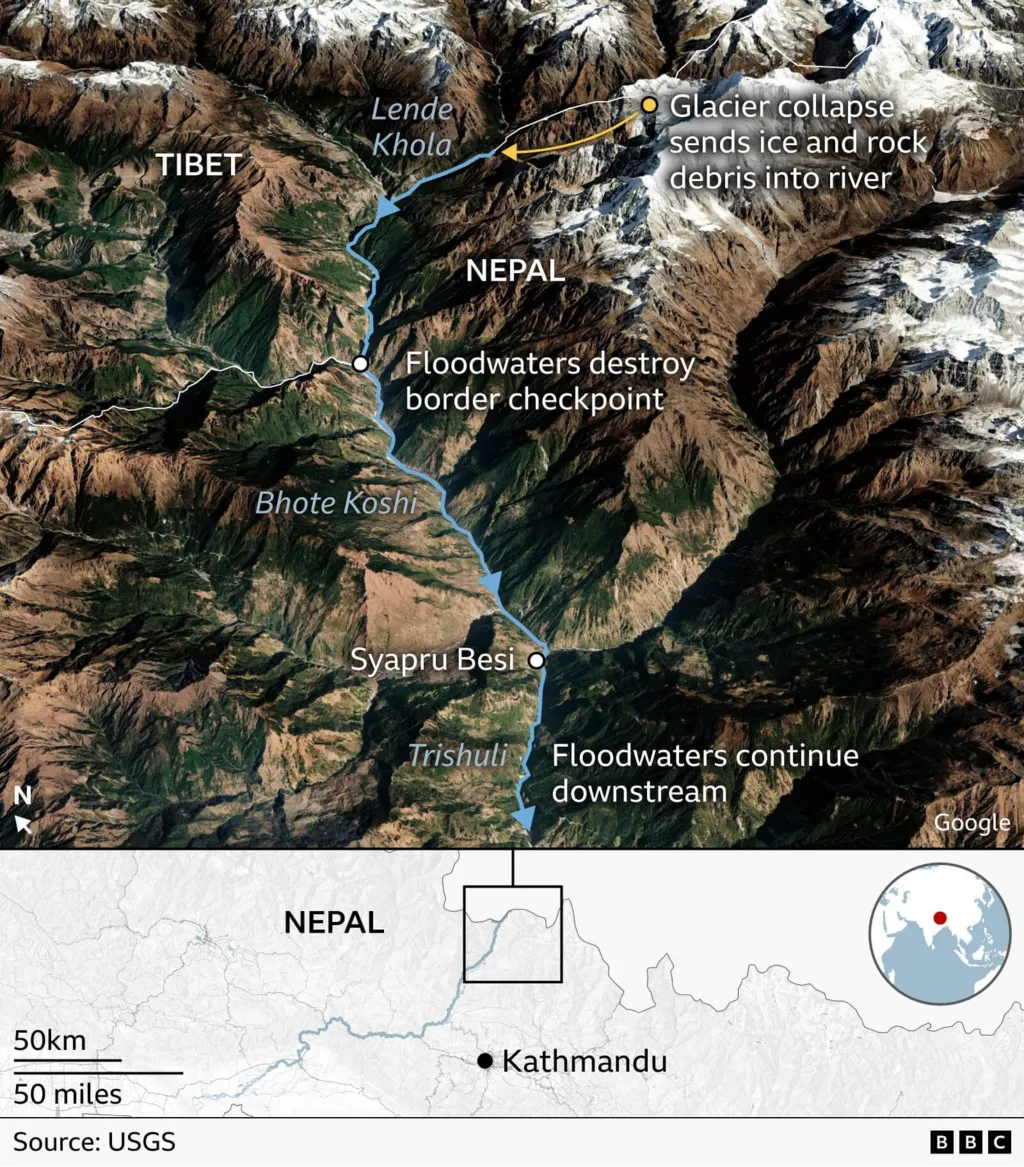
(Source: USGS / BBC.)
High in the Himalayas near the Nepal-Tibet border, the disaster began near the Langtang Lirung Peak. Earlier in the morning of August (26/09), a seismic event with a magnitude of 5.2 shook the region. An earthquake was suspected at first, but scientists at the United States Geological Survey (USGS) ruled that possibility out. Their analysis of early satellite imagery found that the tremor was an impact of a glacier collapsing from Langtang Lirung Peak into the valley floor below.
The collapsing mass turned into an ice-and-rock avalanche that struck Lhende Khola stream, eventually overflowing it into a rapid torrent. The flood wave continued to surge downhill into the Bhote Koshi River and Trishuli River, wiping out dozens of settlements along its 72km stretch. According to Jeffrey Kargel, a senior scientist at the Planetary Science Institute, the flood wave moved at a staggering speed. It covered the first 22 kilometers in just 6 minutes and 50 seconds.
So what may have caused the glacier to collapse?

(Credit: Instagram/@gretathunberg)
For the past week, there has been ongoing public discourse on social media regarding what is really to blame behind the glacial collapse. Some argued that the glacier melted and snapped due to high temperatures, putting the blame on industrial countries with high GHG emissions. On the other hand, some say it’s just a geological event and nothing to do with climate change. As a comment on X mentions, “It’s geological injustice. It sucks to live in the Himalayas, to be sure.”
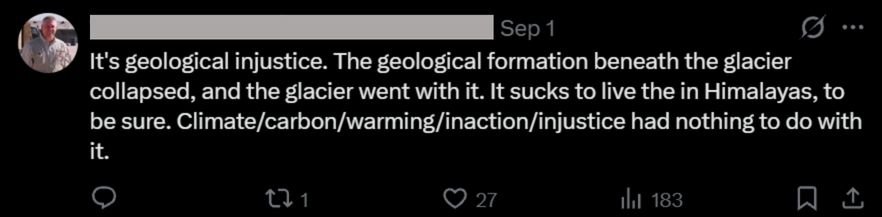
(Credit: X)
Climate Crisis Link to The Glacial Collapse
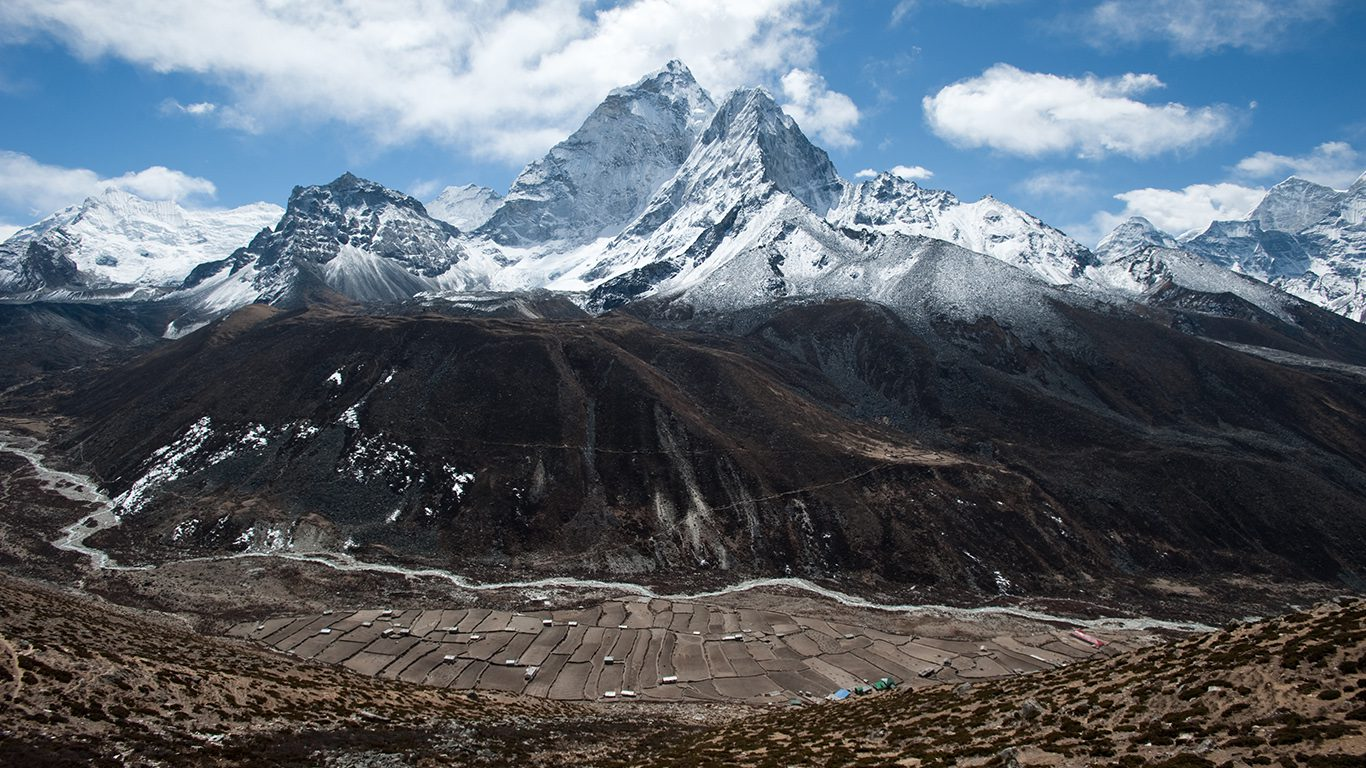
(Credit: Alex Treadway/ICIMOD)
While scientists are still investigating the precise trigger behind the glacial collapse, the disaster fits a pattern driven by global warming. According to two landmark reports by the International Centre for Integrated Mountain Development (ICIMOD) in 2026, the glaciers in Hindu Kush Himalaya have been melting twice as fast since the year 2000. When the glaciers melt away rapidly, local mountain communities may face extreme dangers such as massive downstream flooding due to glacial lake outburst floods.
Speaking to the BBC, Oxford geologist Mike Searle explained that the tragedy is likely the result of two converging forces. The forces mentioned are long-term tectonic uplift, combined with climate-driven high temperatures melting the ice. While small rockfalls are common, entire glaciers collapsing “in one go” represents a concerning shift. Furthermore, satellite observations prior to the collapse revealed unusually warm temperatures around Langtang Lirung, stripping away protective snow cover and exposing bare ice to thermal stress. As Imperial College London hydrology professor Wouter Buytaert noted to CNN, shrinking glaciers naturally become far more prone to breaking apart. This makes it “exactly the type of event that is triggered by climate change.”
Paying the Price for Carbon They Didn’t Burn
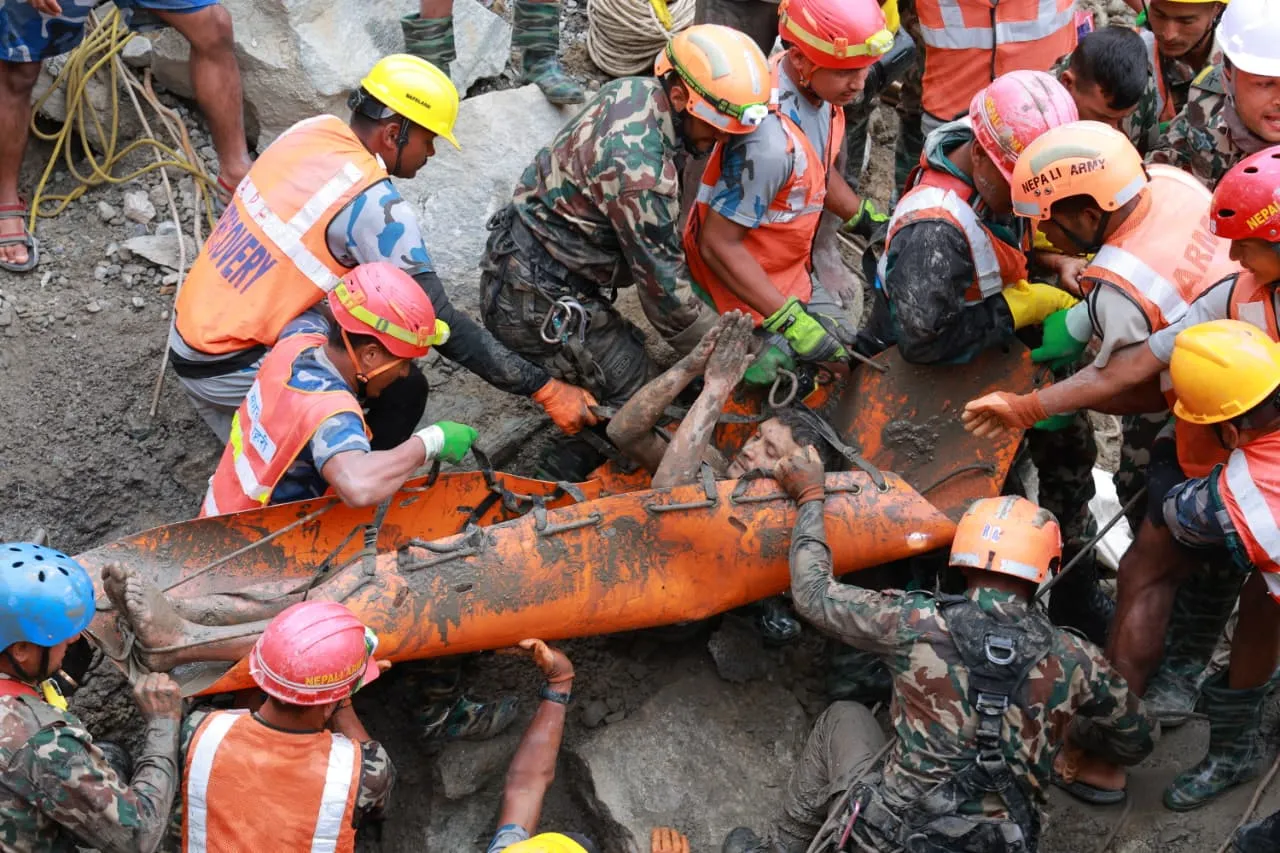
(Photo: Nepal Army Via Associated Press Photo)
The flash flood tore through central Nepal, leaving extensive damage to its districts including Rasuwa, Nuwakot, Chitwan, and Dhading. The trail of ruin can be seen in swept-away bridges, damaged hydropower plants, washed-out roads, and an estimated 20,000 homes in need of rebuilding. While international rescue teams assisted in the search, the treacherous conditions post-disaster hindered efforts to find the missing people. As of September 8, Nepal’s disaster management agency reported at least more than 1,300 people confirmed dead, and more than 5,000 still reported missing.
In response to this tragedy, Minister of Foreign Affairs of Nepal, Shisir Khanal spoke out in a televised interview. “We are paying the ultimate price for a global crisis we did not create. The rapid melting of glaciers and these catastrophic mountain tsunamis are direct consequences of global climate change,” Khanal commented.
Table 1.
Countries Ranked by Global GHG Emission Shares (2025)
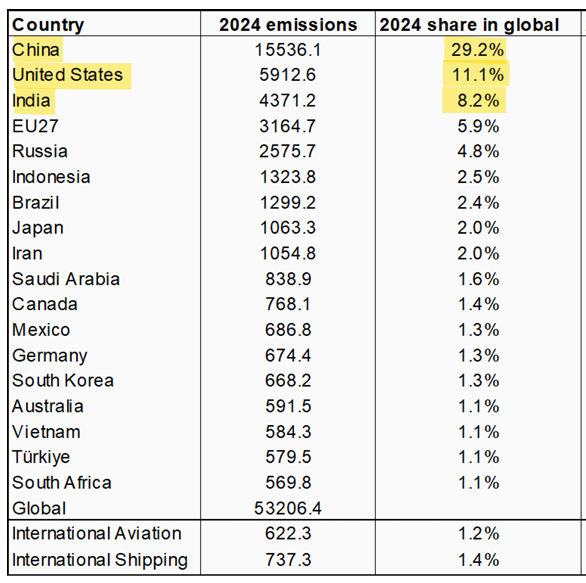
Based on the 2022 World Bank Group Country Climate and Development Report (CCDR) on Nepal, their country barely took part in climate change with a total contribution of 0.1 percent in GHG emissions. Meanwhile, the European Commission’s Emissions Database for Global Atmospheric Research (EDGAR) ranked all the countries with the most GHG emissions. China (29.2%), the US (11.1%), and India (8.2%) combined would amount to nearly 48.5% of GHG emissions. In other words, those three top emitters generate 485 times the amount Nepal does.
To overcome the crisis, Finance Minister of Nepal, Swarnim Wagle stated that Nepal will need $4-$5 billion to fund reconstruction and community recovery. Faced with that financial burden, Khanal rejected the idea of Nepal carrying this cost alone. Instead he called on the top three emitters to help cover damages. “This is not a matter of charity; it is a matter of legal and moral liability,” he stated. Furthermore, Wagle, alongside Nepal’s Ministry of Environment, has written a joint letter to the United Nations with a request for $20 million in damages.
Reporter: Dzakira Azhlianisa
Editor: Elga Thalita Perangin Angin, Khayla Dinda Pradwina, Fernaldhy Rossi Armanda