
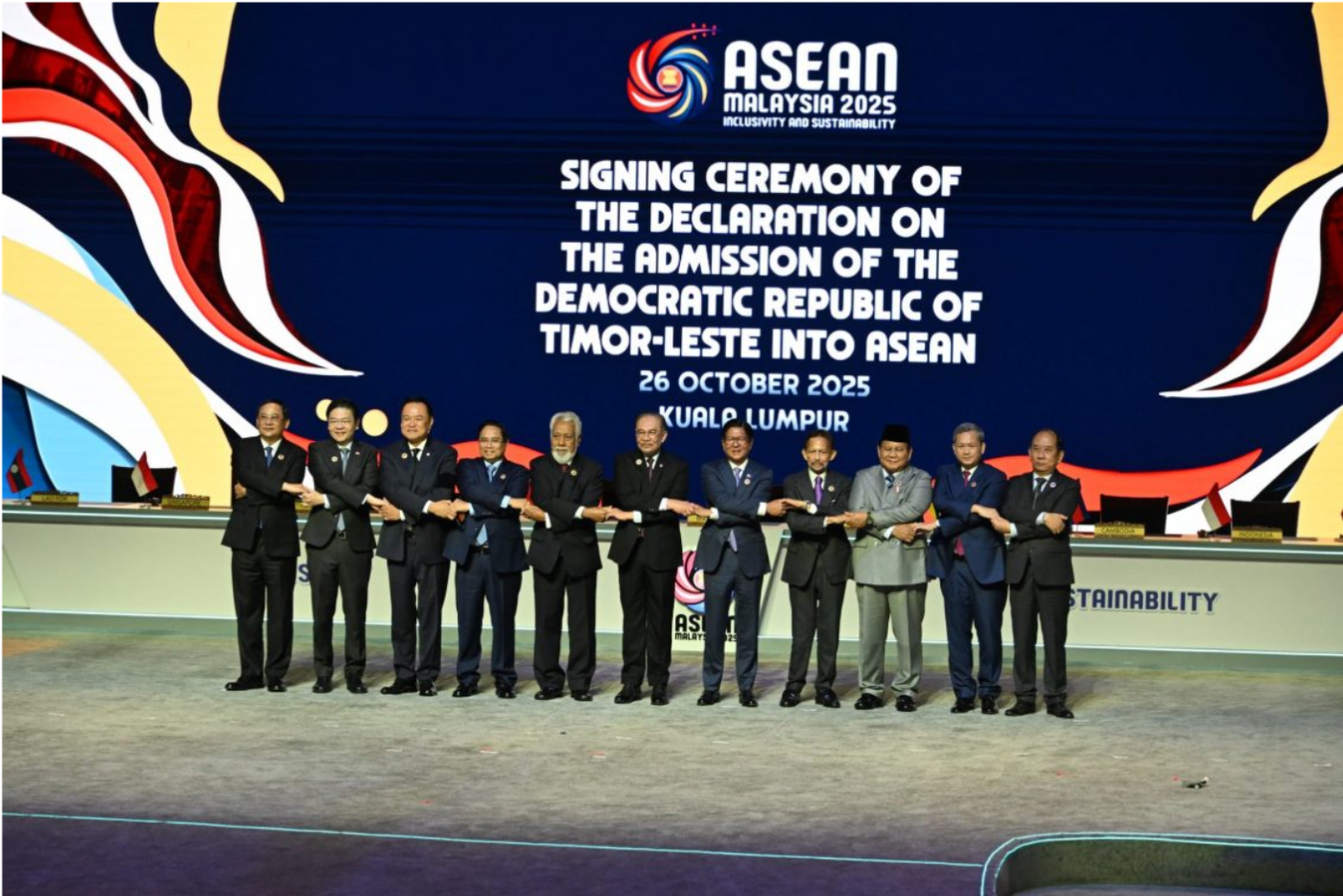

ASEAN state leaders are attending the signing ceremony recognizing Timor Leste as an official member of the association. (Source: ASEAN.org official portal)
Warta Kema – On Sunday (26/10) at the 47th Association of Southeast Asian Nations (ASEAN) Summits and Related Summits, Timor Leste was officially announced as an ASEAN member through the Signing of the Declaration of the Admission of Timor Leste. This inauguration marks a major milestone for the country, which has been cooperating closely with the organization since its establishment as an independent nation.
According to AP News, Timor Leste’s prime minister, Xanana Gusmao, mentioned the sentiments of honor this key milestone has for the country. Through his speech, Gusmao highlighted the long struggle the Timorese people have felt, and that the acceptance of their country into ASEAN flooded their people with aspirations.
“Today, history is made. For the people of Timor Leste, this is not only a dream realized, but a powerful affirmation of our journey– one marked by resilience, determination and hope,” he shared.
The declaration recognizes Timor Leste as the eleventh member of the association, twelve years after the nation’s first membership application in 2011. The event came after ASEAN leaders agreed to admit Timor Leste as a member state and grant it observer status in ASEAN meetings in 2022. According to ASEAN’s official website, this declaration was also a byproduct of the adoption of the Roadmap for Timor Leste’s Full Membership in 2023, which was a program designed to help the nation in achieving the requirements to meet ASEAN’s membership criteria, including legal instruments and meeting attendance.

Timor Leste’s Prime Minister Xanana Gusmao, alongside other ASEAN member state leaders, during the declaration at the 47th ASEAN Summit in Kuala Lumpur. (Source: ASEAN)
Timor Leste is the youngest country in Southeast Asia. Formerly known as East Timor, the country gained its independence after 24 years of Indonesian occupation and conflict. This independence movement came true when the crisis of 1998 hit Indonesia, along with the fall of Soeharto’s 32-year dictatorship, creating an opportunity for a referendum that gave East Timor the chance for self-determination and independence. According to the Diplomat, Timor Leste’s independence was further strengthened by the New York Agreement in 1999. The agreement, whose discussions centered on support for East Timor signed by the Secretary-General of the United Nations and the Minister of Foreign Affairs of both Portugal and Indonesia, solidified the country’s declaration.
The acceptance of Timor Leste into ASEAN brings several implications for the future of the young nation. According to Tempo, observers mentioned that the integration of Timor Leste highlights ASEAN’s commitment to regional cohesion. Ever since the initial acceptance as an observer, Timor Leste has already been involved in key ASEAN meetings while adopting the bloc’s political, economic, and socio-cultural foundations into its national frameworks. Being a member of the association will open new opportunities for Timor Leste to engage more actively and directly with other member states in agreements.
This also puts Timor Leste in a strategic position to negotiate first-hand with ASEAN’s key partners such as China, Japan, India, Australia, Russia, South Korea and the United States, whom Timor Leste’s representatives have already had high engagements during the summit after the country was declared as a member. Giving membership to Timor Leste provides them a vital platform to contribute to shaping regional political landscapes, specifically in the Southeast Asian region. The move also showcases ASEAN’s commitment for inclusion.
However, the question of whether this integration will fully benefit both Timor Leste and ASEAN altogether still remains. Timor Leste, according to the Lowy Institute, faces several domestic challenges, including excessive reliance on petroleum revenues, which causes the country to have a vulnerable economic condition. This is reflected in the low Gross Domestic Product (GDP) per capita rate, slow economic growth, heavy imports, and severe poverty the country suffers from.
While the integration into ASEAN will surely grant better market access, direct foreign investment and aid, it still doesn’t guarantee a sure result on how the country will transform under the association’s care. However, for a country that has faced two decades of uncertainty with resilience, the hopes and grit of the Timorese people should hopefully shine through once more, one step at a time.
Reporter: Andrea Hillary Gusandi
Editor: Syafina Ristia Putri