
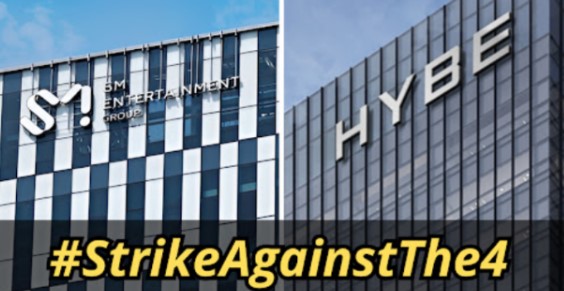
Fans Organize Boycott Of K-Pop’s ‘Big 4’ Companies In Support Of Palestine (Source: Koreaboo)
Warta Kema – In a stunning display of fandom power intersecting with global activism, K-pop enthusiasts worldwide have ignited a viral movement hashtag #StrikeAgainstThe4, urging a boycott of South Korea’s Big 4 entertainment companies: SM Entertainment, YG Entertainment, JYP Entertainment, and HYBE Corporation. The movement, which exploded across social media platforms and had been ongoing since 2024, stems from outrage over these companies’ affiliations with American brands accused of supporting Israel’s genocidal actions towards Palestine. As the hashtag continues to trend into late 2025, it raises profound questions about the role of pop culture in geopolitics, the ethics of celebrity endorsements, and the growing influence of “cancel culture” in the digital age.

K-pop fans tweeting what the #StrikeAgainstThe4 is about and why it matters. (Source: @namgiiist on X)
The campaign gained momentum from a widely reposted tweet that encapsulated the fans’ fury. “In solidarity with the citizens of Palestine, we have declared a strike against the Big Four corporations. MERCH & MUSIC WILL NOT BE BOUGHT OR STREAMED,” stated by fans on X.
The post elaborated that the boycott was aimed at these companies, not because of their own actions, but due to their collaborations with international brands such as McDonald’s that have allegedly donated millions of dollars to Israel, enabling the events of genocide in Palestine. As reported in an October 2025 article in Brussels Morning, McDonald’s first entered Israel in 1993 and currently operates more than 200 outlets, the majority of which are franchised by a company called Alonyan. The company provides jobs, accommodates halal food needs, and avoids taking sides in global politics. However, a large portion of people interpret McDonald’s presence in Israel as support for the Israeli government. As reported by CNBC Indonesia in 2023, McDonald’s reportedly donated thousands of meals to the Israel Defense Forces (IDF) in its conflict with Hamas. This prompted global condemnation and boycott of McDonald’s, including among K-pop fans.

McDonald’s South Korea Instagram Post on September 29th (Source: @mcdonalds_kr)
The #StrikeAgainstThe4 initiative has seen fans compile lists of K-pop idols whose agencies are entangled in these affiliations, pressuring entertainment firms to sever ties. K-pop, with its massive international fanbase, has become an unexpected battleground. Fans are giving negative responses to idols’ collaborations and affiliations with boycotted brands, one of which includes the McDonald’s advertisement featuring K-pop idol Mark Lee. Fans are viewing these as tacit endorsements of companies linked to Israeli military funding.
This phenomenon ties directly into “cancel culture,” a term coined in 2016 to describe the collective withdrawal of support from individuals or entities deemed problematic. Derived from Merriam-Webster on 29 October 2025, cancel culture is defined as the practice or tendency of engaging in mass canceling as a way of expressing disapproval and exerting social pressure, and in K-pop, it’s proving potent. Fandoms here are no strangers to activism; they’ve mobilized for causes ranging from mental health awareness to human rights. The #StrikeAgainstThe4 campaign exemplifies how fans wield immense economic power. K-Pop’s global market is worth billions, with streaming and merchandise sales driving profits, especially as digital platforms like Spotify and YouTube amplify fan voices. Fans are the lifeblood of K-pop and the reason why the industry thrives and can’t be ignored. When they unite, taking a uniform stance through mass protests and boycotts, agencies have no choice but to listen, because without fans, the whole system shuts down. It’s a stark reminder that entertainment isn’t just fun; it’s deeply tied to real-world actions and consequences.
#StrikeAgainst4 also exemplifies the intersection of pop culture and politics. In an era where social media instantly transforms fans into activists, K-pop’s global reach can amplify voices that might otherwise go unheard. This movement allows agencies to be more careful in their partnerships and avoid working with companies or brands that are at odds with human rights. #StrikeAgainstThe4 has sparked important conversations about corporate responsibility and the moral weight of celebrities. This movement proves that in the world of K-pop, fans are not passive observers; they are agents of change with unprecedented power.
Reporter: Ardisty Mutiara Kamulya
Editor: Putri Adelia Ardini, Maheswara Adla Wibowo, Andrea Hillary Gusandi, Syafina Ristia P