
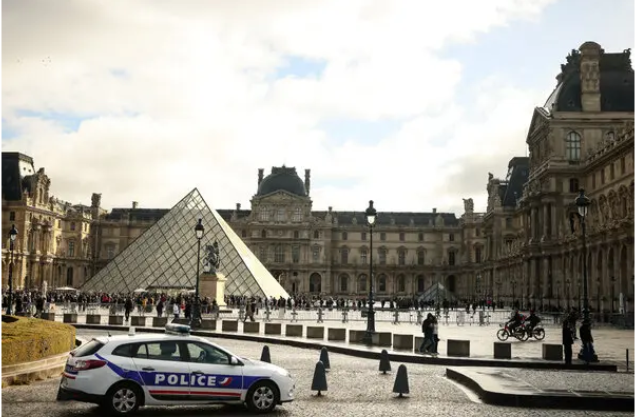
Louvre Museum Heist (Source: The New York Times)
Warta Kema – The iconic Louvre Museum in the capital city of France has suddenly closed on Sunday (19/10/2025) after a sudden group of thieves broke in and stole several French monarchy jewels in the museum’s D’Apollon gallery in broad daylight. Online media and netizens alike believed it to be “the most hit-heist in century” because they stole eight jewels in quick succession and managed to escape swiftly. Reports also said that the robbery was highly coordinated. It sounds like a plot of a heist movie, doesn’t it?
As the French police track down the thieves and the stolen jewels, a number of questions arise surrounding the event. How was the robbery done? How did they manage to pass on the security? And what will they do to the jewels? The people of France are now concerned with the state regarding the museum’s security system and the loss of the historical objects.
A Seven-Minute Robbery That Stunned France
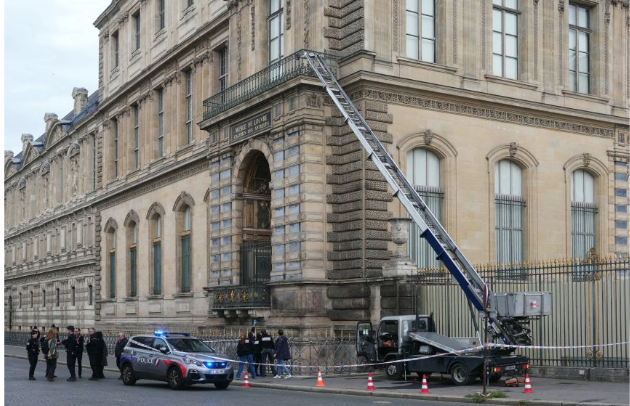
Louvre thieves used the lift from a mechanical truck to enter the museum from above (Source: CNN)
On Sunday (19/10) at around 9.30 in the morning, a group of four people arrived at the museum a few minutes after it opened at nine. They dressed as construction workers, their faces hidden beneath masks and arrived quietly outside the Louvre near the Seine River with a utility truck. The construction workers’ costumes they wore seemingly made their surroundings unsuspecting of anything unusual, even though further investigation by authorities later on revealed there were no utilities stored in the truck they travelled in.
At 9:32 AM, they went to the museum’s D’Apollon gallery– a gold-gilded, lavishly painted hall commissioned by King Louis XIV as the home to France’s crown jewels, through the balcony using extendable mechanical ladders from the truck. Deriving underneath the truck, one man kept watch, scanning the street for anything unusual, while the other steadied the equipment. The other two reached the balcony carrying tool bags packed with power drills. Every movement was calm, practised, and precise.
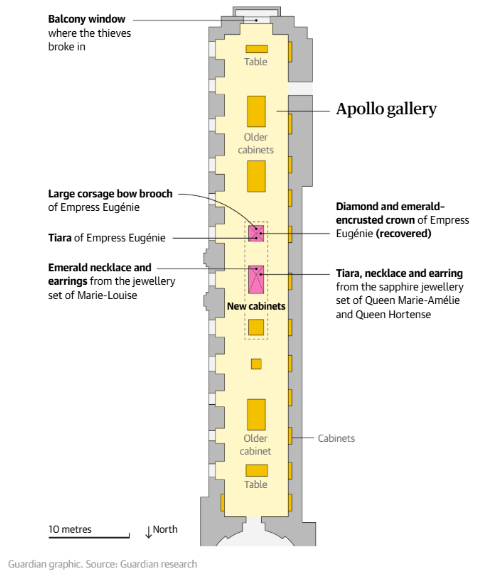
The map floor of the museum’s D’Apollon gallery (Source: The Guardian)
At 9:34 AM, they broke into the gallery using an angle grinder against the reinforced window glass and made it inside the gallery. The thieves pressed a thermal blanket over the sensors, masking their intrusion. A red warning light flashed at first inside the control room, but the security ignored it as a false alarm from the week’s renovations. They realized that mistake minutes later, too late.
Once in there, they didn’t waste time. In four to seven minutes, the intruders smashed the two glass display cases using power tools, including disc cutters. They went to the middle of the gallery where the targeted items were located, which are the nine pieces of the French Crown Jewels. They stole it and scooped it into black canvas bags. Soon after, alarms started to sound.
At 9:37 AM, the security responded from the Mona Lisa Gallery, followed by the staff abiding by safety protocols, locking down the room, avoiding a physical fight with the robbers and starting the evacuation of the museum immediately. However, the delay in their reactions was what all the thieves needed to grab the jewels and retrace their steps out of the window.
At around 9:38, the two men slid down the ladder to meet their accomplices. The thieves managed to escape by roaring off on two high-powered scooters. But not everything went according to plan. In their rush, the 19th-century crown was dropped from their motorcycles and discarded on the ground. In total, the group got away with eight items worth over $100 million.
By the time museum security reached the riverbank, the scooters were gone. Police alerted, sirens erupted across the city as barricades rose. It was here that the helicopters took flight. However, the thieves, whoever they were, had melted into the morning traffic.
Later, authorities found the fallen crown in a nearby alley, lying damaged on the ground. Inside the Louvre, police sealed entrances, and the museum was closed for the remainder of the day. Forensics teams lifted prints from the lift’s controls, pulled surveillance footage from interior corridors and exterior streets. The initial investigation conclusion was quickly shaped.
In a TV interview on TF1, the French Cultural Minister, Rachida Dati, said at the site alongside the museum staff and police that the heist caused no physical harm. No victims were injured. She described from the footage she saw that the robbers do not target people. They enter “calmly”, smash display cases, take their loot, and leave. She called the heist “very professional and no violence”.
The Priceless Jewels They Stole
Officials confirmed that the thieves successfully stole nine items from two high-security display cases, but one fell into the street. The items include pieces that belonged to Empress Marie-Louise, the wife of French Emperor Napoleon I, and others that belonged to Empress Eugenie, the wife of Napoleon III. All of the jewellery they stole was believed to be worth more than $100 million.
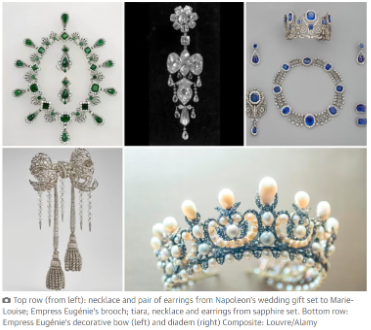
The eight items the burglars successfully stole (Source: The Guardian)
The eight items the burglars made off with are:
- A necklace and a pair of earrings originally given by Napoleon I to his second wife, Empress Marie-Louise.
- A diadem (similar to a tiara), a brooch and a decorative bow belonging to Napoleon III’s third wife, Empress Eugénie. The diadem is dotted with nearly 2,000 diamonds.
- A tiara, necklace and single earring from a sapphire set worn by – among others – Marie-Amelie, the last queen of France. The necklace is adorned with eight sapphires and 631 diamonds.
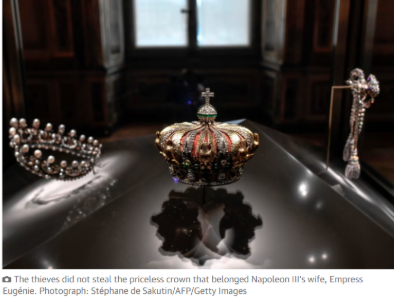
The crown of Empress Eugénie, the wife of Napoleon III (Source: The Guardian)
The thieves dropped Empress Eugénie’s hugely valuable crown on their way out and damaged it. The crown is covered in 1,354 diamonds and 56 emeralds. According to museum officials, the crown will be restored through the scientific committee’s supervision and funding from the patrons. Nevertheless, the crown will not be exactly as before due to some of the pieces of the crown such as the diamond and gold missing.
The Post-Theft Events and Investigation
A few days later, after the robbery, on 22 October, the museum reopened to the public, though the gallery itself still remained closed due to investigations still being in process. According to French prosecutors, more than 100 investigators have been tasked to track down the suspects. They are analyzing DNA traces, security footage, and escape-route evidence.
According to Reuters, the investigators describe that the heist was carried out professionally and well planned, from the entire heist operation, entry method, and target selection. However, they also left some sloppy errors at the same time. The police found some evidence left behind besides the crown such as the power tools, a blowtorch, gloves, a walkie-talkie, and a jerrycan of gasoline (used in a failed attempt to torch the truck).
Yet, after the long process of tracking down the suspects, the Paris public prosecutor Laure Beccuau revealed that the Louvre heist suspects weren’t professionals but “petty-criminals”. The suspects that police currently charge were “local people” from Seine-Saint-Denis, a northern suburb of Paris.
Four people were arrested, including a 37-year-old man and a 38-year-old woman whose DNA was reportedly found on the lift used in the heist. The man has been charged with coordinated heist and criminal conspiracy, while the woman faces charges of complicity in organized theft. The prosecutor described them as a couple with children who “denied any involvement”. Three additional people were also detained with the couple on 29 October but later released without charge.
The other two are men, aged 34 and 39, who were arrested earlier on 25 October. The 39-year-old man was revealed to be a social media star named Abdoulaye N, who runs YouTube and TikTok channels under Doudou Cross Bitume, where he performs tricks on motocross in Paris and Aubervilliers. All of them were charged with theft and criminal conspiracy. Both had previous convictions for theft, and the prosecutor said they had “partially admitted” their involvement.
Moreover, the investigators revealed that the museum has chronic under-investment in museum security, with outdated systems and incomplete camera coverage. In response, Rachida Dati ordered rapid upgrades and installed anti-intrusion barriers to upgrade the museum’s security. However, the condition of the museum’s security caused intensified debates by the public over institutional accountability and how one of the world’s most iconic museums could be so vulnerable to such a meticulously planned theft.
While the suspects are now in custody and the museum’s security is in repair, some of the jewels remain missing. Nearly a month after the heist, investigators still haven’t recovered the stolen jewels. Paris public prosecutor Laure Beccuau said that “all avenues are being explored.” According to The Guardian, investigators have collected more than 150 DNA and fingerprint samples from tools and clothing left behind, but the prosecutor has only “small hope” of recovering the jewels.
The Officials’ Acknowledgement vs the Public Concerns
Director of the Louvre Museum, Laurence des Cars, acknowledged serious shortcomings in the museum’s surveillance systems, noting that perimeter cameras were insufficient. She called the incident a “terrible failure” for which she took her share of responsibility by offering to resign, but was refused by the Culture Minister.
The Minister also acknowledged the museum’s “security gaps”. She cited four failings, like underestimated risk of intrusion and theft, under-equipped security, Ill-suited governance, and “obsolete” (old or outdated) protocols.
The public also has the same concern and disbelief regarding the lack of security, misplaced institutional priorities, and loss of irreplaceable cultural heritage. They all see the fundamental security failures as amateurish and embarrassing for a world-class institution, especially the password “LOUVRE” becoming viral and a symbol of systemic, lazy negligence in cybersecurity. Civilians were also concerned about how the museum’s leadership and the French state had actively ignored security warnings, choosing to prioritize visitor experience and spectacle over core protection. As a consequence, people are disappointed and criticize the museum management and the stolen objects that transcend their monetary value, becoming a national “humiliation” and a sign of the state’s failure to protect its most sacred assets.
The head of the state auditor, Pierre Moscovici, called the theft a “deafening wake-up call” and stated that the pace of security upgrades was “wholly inadequate.” The report found that the Louvre’s investments had prioritized “visible and attractive operations” (like visitor experience and new art) at the expense of maintenance and security systems.
The heist also inevitably spilled itself into politics. Far-right leader Jordan Bardella used it to attack President Emmanuel Macron, who is facing a fractured parliament. “The Louvre is a global symbol of our culture. This robbery, which allowed thieves to steal jewels from the French Crown, is an unbearable humiliation for our country. How far will the decay of the state go?” he wrote on X.
Macron said on X that France would recover the works, and the perpetrators will be brought to justice, and he also stated: “The theft committed at the Louvre is an attack on a heritage that we cherish because it is our history.”
The Paris Prosecutor Laure Beccuau also called it “an extraordinary” financial loss because of the greater damage left to France’s historical heritage.
The Louvre Museum Heist as an Inspiring Movie Plot
While most took the heist as something serious, there were also some amusing reactions from the public, particularly online. Many people “glorify” the heist on social media as a thrilling spectacle inspired by fictional-made heist stories such as the Hollywood movie Ocean’s 8, the French series Lupin, the Netflix animated series Carmen Sandiego, the Six of Crows novel by Leigh Bardugo, and many more.

Ocean’s 8 Movie (Top Left), Lupin Series (Top Right), Carmen Sandiego animated series (Bottom Left), and Six of Crows (Bottom Right)
(Source: Pinterest)
At the time of the event, the heist became a trend on TikTok. On the platform, many users made edits and memes (jokes). One user made the event as an inspiration for their Halloween costume, and even wrote their own fictional stories about it. The Gen-Zs are wishing that they could be a part of the heist. This reflects a modern trend of “romanticizing” fictional criminals.
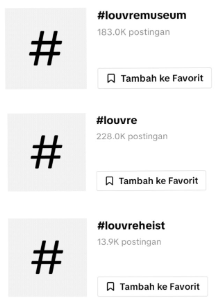
Hashtags about Louvre Heist in Tiktok

Example meme of Louvre Heist (Source: Tiktok)

Example of content trends of Louvre Heist (Source: Tiktok)
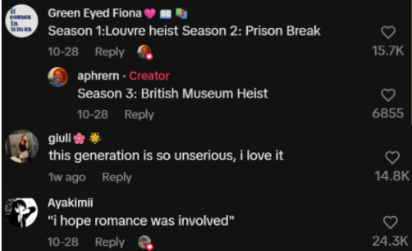
Example of comments about the Louvre Heist (Source: TikTok)
The Louvre Museum as France’s identity
For the French, the Louvre is more than just a museum. What was once a royal palace became a public treasure house that France prides itself for. It represents the country’s history and sits at the centre of French culture and identity. That’s why it was supposed to be untouchable. The cultural and historical value of the Louvre turned it into an impregnable fortress guarded by scanners, cameras, and a small army of staff. It was believed to be the most secure place for any priceless piece of art.
Yet, on the quiet Sunday morning of October 19th, that illusion came crashing down. In a heist that lasted only 7 minutes, a crew slipped in through the second-floor window of the gallery like a scene from Oceans 11 and emptied two cases of crown jewels. By noon, streets were shut off. The French public was in shambles and every screen in Paris carried the same headline. A sprawling international manhunt is underway this morning after thieves took priceless jewels from the Louvre Museum in Paris. This wasn’t just a robbery and a loss of monetary value. It was a major blow to national heritage, a strike at France’s history and its national pride.
Beyond the thrill of a real-life “movie moment,” the event serves as a reminder that cultural heritage is not only a matter of beauty and prestige, but also of vigilance and responsibility. Whether viewed as a tragedy, a wake-up call, or a cinematic spectacle, the Louvre heist will remain etched in history as both a mystery and a mirror reflecting the vulnerabilities of our times.
Reporter: Elga Thalita Perangin Angin
Editor: Putri Adelia Ardini, Maheswara Adla Wibowo, Andrea Hillary Gusandi, Syafina Ristia P