
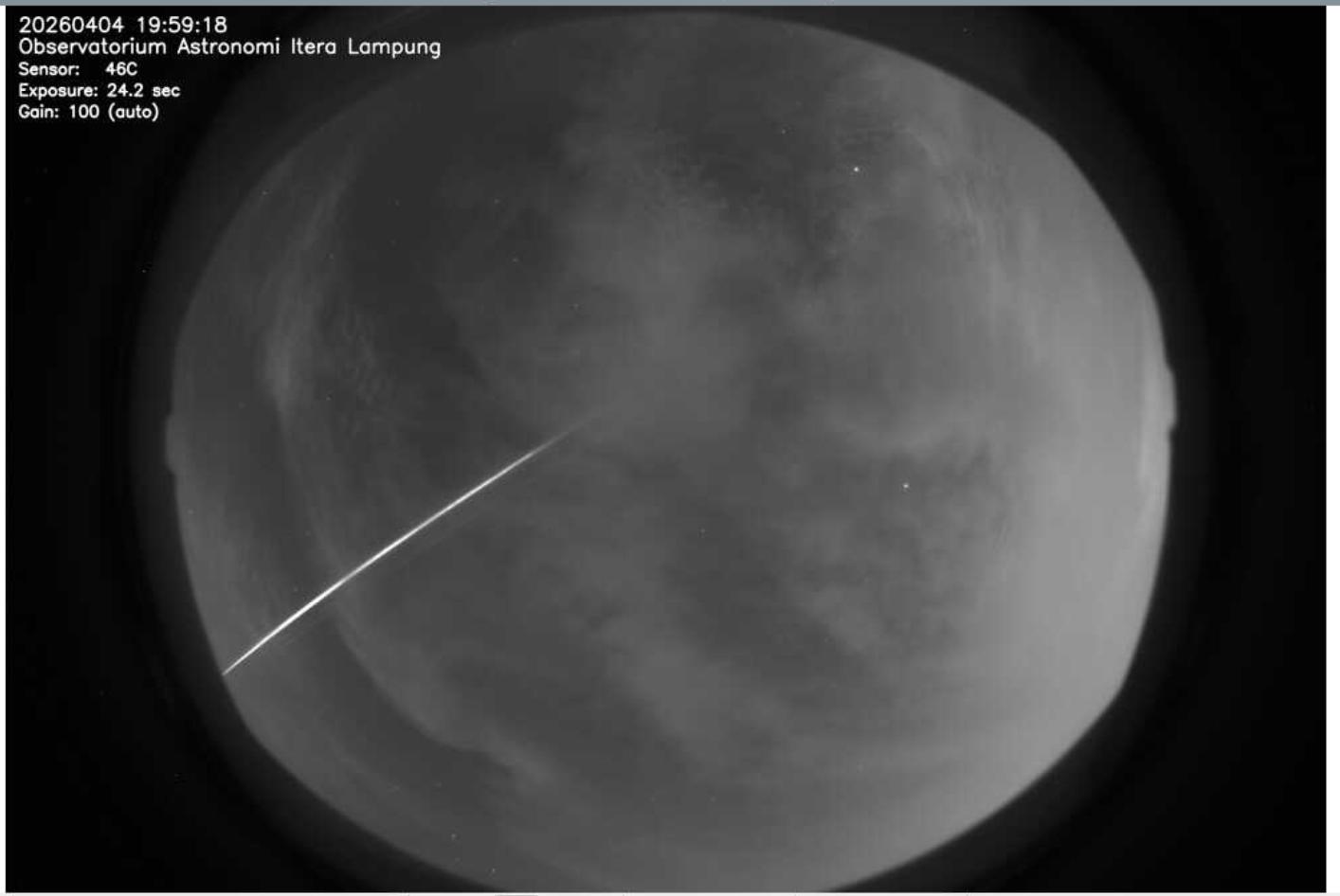
Warta Kema – The phenomenon of falling space debris on Saturday (4/4) shocked the Indonesian public after a luminous object passed over the skies of Lampung and Banten, initially mistaken for a meteor shower.
Indonesia’s National Research and Innovation Agency (BRIN) confirmed it was space debris from a Chinese Long March 3B (CZ-3B) rocket re-entering Earth’s atmosphere. “Residents in Lampung and Banten were shocked by a bright burning object they saw in the sky, which later broke into pieces. We can confirm that it’s space debris,” said BRIN astronomy Professor Thomas Djamaluddin on Sunday. Head of the ITERA Lampung Astronomical Observatory Center (OAIL), Dr. Annisa Novia Indra Putri, S.Si., M.Si., explained that the CZ-3B R/B object was part of a Long March 3B rocket that China previously used for a satellite launch mission on January 23, 2025. After completing its mission, the rocket section remained in low Earth orbit (LEO) before finally descending due to atmospheric drag.
The debris descended below 120 km around 7:56 p.m local time, traveling from India towards the Indian Ocean, and became visible along Sumatra’s western coast. Friction with the atmosphere caused the bright object to burn and break into pieces, creating a spectacular sight captured on viral video. “When a celestial body enters Earth’s atmosphere at high speed, friction with air particles causes the temperature to increase and triggers the combustion process,” said Dr. Annisa. Residents described it as a meteor, sparking panic, but no reports of damage or injuries.
Space debris has become an increasingly pressing global issue with the rapid growth of space exploration in recent decades. Debris contains hazardous materials, such as radioactive uranium, that would cause contamination on land. The number of unused objects orbiting Earth continues to increase, including satellites that are no longer functioning, rocket debris, and even the remains of collisions between space objects.
In response, a physics lecturer at Universitas Gadjah Mada (UGM), Dr. Dwi Satya Palupi from the Faculty of Mathematics and Natural Sciences, urged the government to immediately form a special team to monitor and anticipate falling space debris, considering the potential for similar incidents to reappear and endanger ecosystems if not handled seriously. She warned that increasing debris volume raises the risk of collision with populated areas or infrastructure, potentially endangering ecosystems through contamination or physical damage. “Therefore, a special team is needed to monitor space debris that might fall in Indonesian territory,” she explained on Wednesday (8/4). Dwi explained that although such phenomena can be predicted in advance through applications that monitor incoming space objects, such as those used for debris, these incidents of falling space debris can be predicted in advance through a dedicated application. “If such an application doesn’t exist yet, Indonesia should definitely start developing one,” she said. She emphasized that reducing debris requires a strong global commitment.
While international standards, such as the Inter-Agency Space Debris Coordination Committee (IADC) guidelines, promote mitigation measures, including post-mission disposal, they were derived from voluntary cooperation, without legal obligations, highlighting significant gaps in international legal and policy enforcement regarding space debris. Dr. Dwi Satya highlights the need for a coordinated national team.
International policies on space debris management have existed since the beginning of space exploration, including the Liability Convention, the Inter-Agency Space Debris Coordination Committee guidelines, and the United Nations Committee on the Peaceful Uses of Outer Space (COPUOS) Debris Mitigation guidelines. However, the implementation still needs improvement due to the absence of an effective enforcement mechanism by states or private companies to ensure compliance with debris mitigation regulations, an explicit international legal obligation to clean up existing debris, and the lack of binding international obligations in mandating the removal of existing debris.
Weak cooperation between launching nations has further aggravated the problem. The absence of coordinated international policies and monitoring systems makes effective debris mitigation difficult. As a result, space debris continues to accumulate in orbit, increasing the risk of collisions and threatening active satellites. Therefore, clearer international standards and implementation mechanisms are needed to ensure sustainable space debris management and the safety of future space exploration.
Reporter: Varadwina Clara Tsabitah
Editor: Elga Thalita Perangin Angin, Khayla Dinda Pradwina, Fernaldhy Rossi Armanda